
Customers Delegating to AI, One Job at a Time

Datapay, Design & Research Lead
May 2025 – Current
CAB satisfaction
93/100
Satisfaction from our Customer Advisory Board (CAB), our highest-rated yet.
NZ payroll experts
12
validated the D1–D5 AI delegation framework directly.
Datapay set out to define what AI could look like for our payroll platform, not just where to add it as a feature like a chatbot. How it could enhance our customers experience by helping get their jobs done more efficiently. Also from a product and build point of view, how AI works work behind the scenes to map data quickly and increase build capacity.
I created a AI delegation framework, validate by our NZ Enterprise Payroll Leaders, we understand how much they wanted to hand over and where to start. We then used this to design and validate our first AI-assisted workflow for our internal Payroll Consultants who are the biggest beuro in New Zealand. The AI is customer facing but also importantly the machanics behind the scene that enable us to build faster than ever and confidently map the data. Helping both customer and internal Consultant get their job done quicker and more accurately.
The result is a shared framework for delegating work to AI including a risk matric for the jobs, grounded in what consultants and customers said they were comfortable with, not just what was technically possible. I've since shared the research insights across multiple customer workshops, and represented Datapay at the NZ Payroll Association's industry session on Secure AI in payroll.
“
Everyone has varying confidence in AI, but we are all on the same track on what we would like to use it for in payroll... The whole day was worthwhile, and I think the best to date.
CAB participant

Deadline-driven, high-stress work, especially around payday. Research showed us where to reduce the cognitive load.
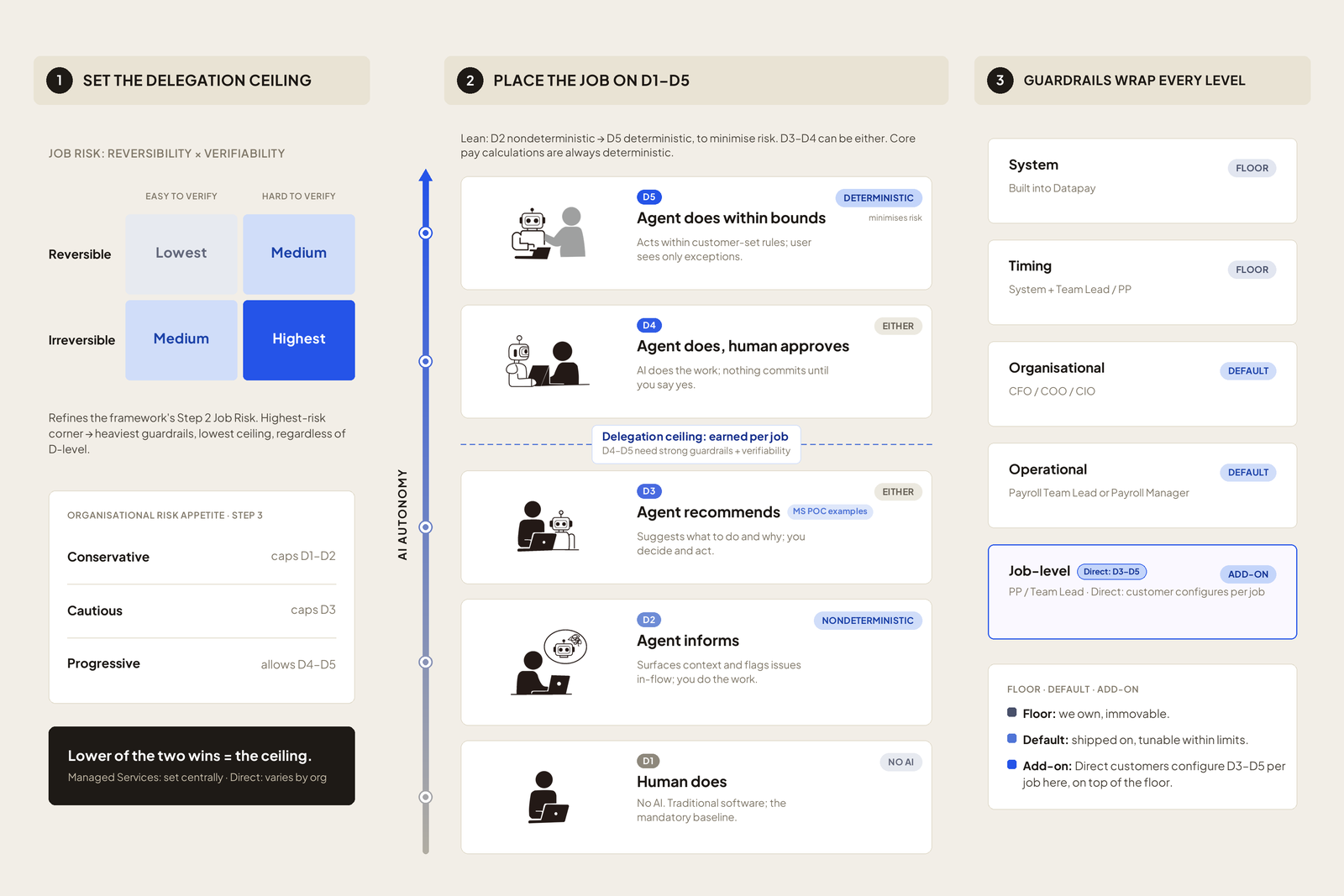
Risk matrix guiding AI delegation
My Role
As Design & Research Lead, I own how Datapay approaches AI delegation, from framework through to customer validation. Key partnerships along the way: internal managed services payroll consultants, AI engineers on feasibility, other product leads to help run customer facing workshops, account managers on the customer relationship, and our GM of Customer Success on reach.
The Situation I Walked Into
Conversations about AI tended to default to "more automation is better," without checking that against what payroll consultants or customers actually wanted. There was no shared language for what AI should and shouldn't take on across the product.
There was a strong foundation to build from, previously validated Jobs-to-be-Done research I'd led was shaping product decisions, so this wasn't starting from nothing. What was missing was a way to talk about delegation that didn't default to "AI does everything", we needed a better framework and customer understanding than the simplistic “human on the loop”.
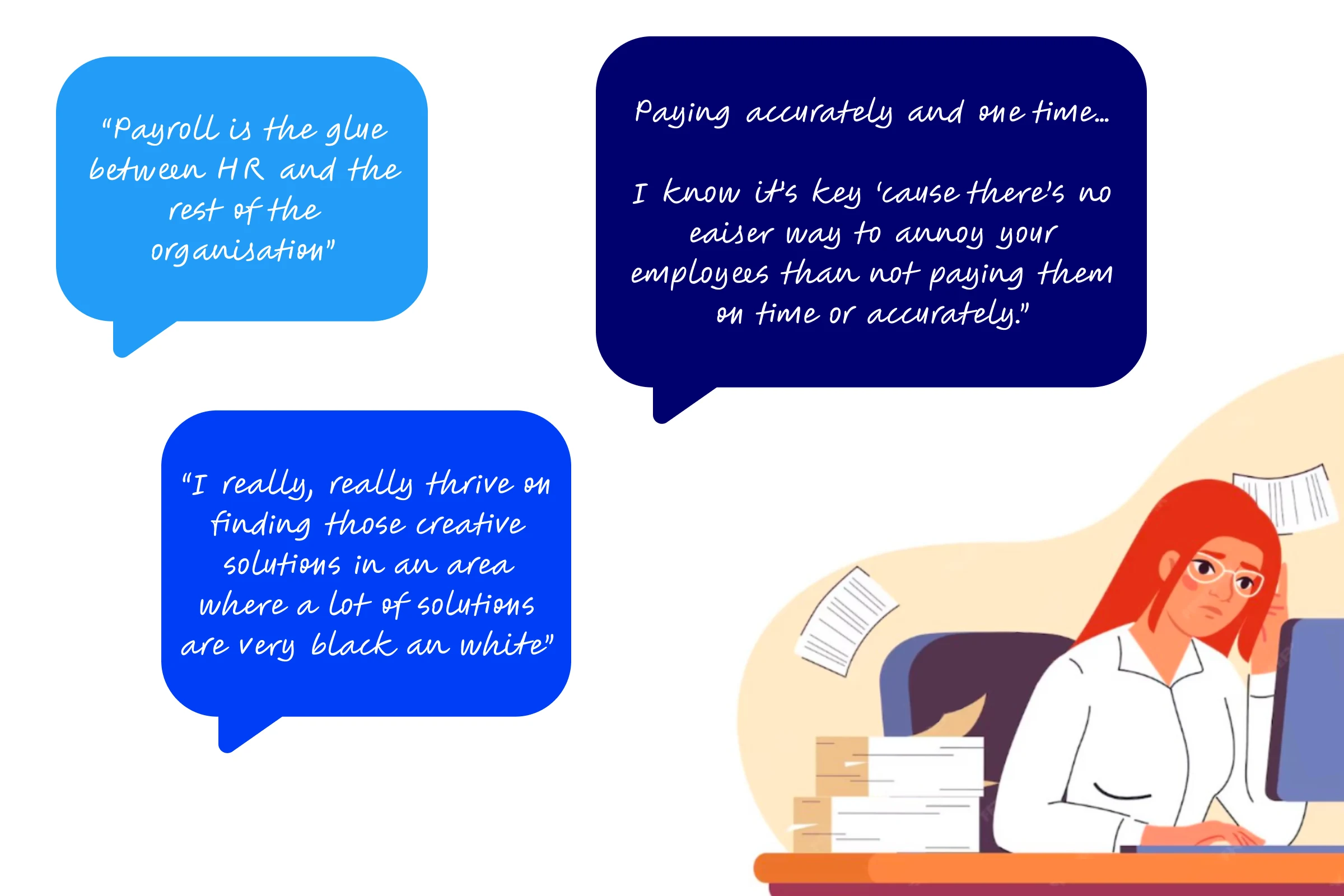
Synthesised from 21 research projects, five of mine. The theme was always accuracy and trust.
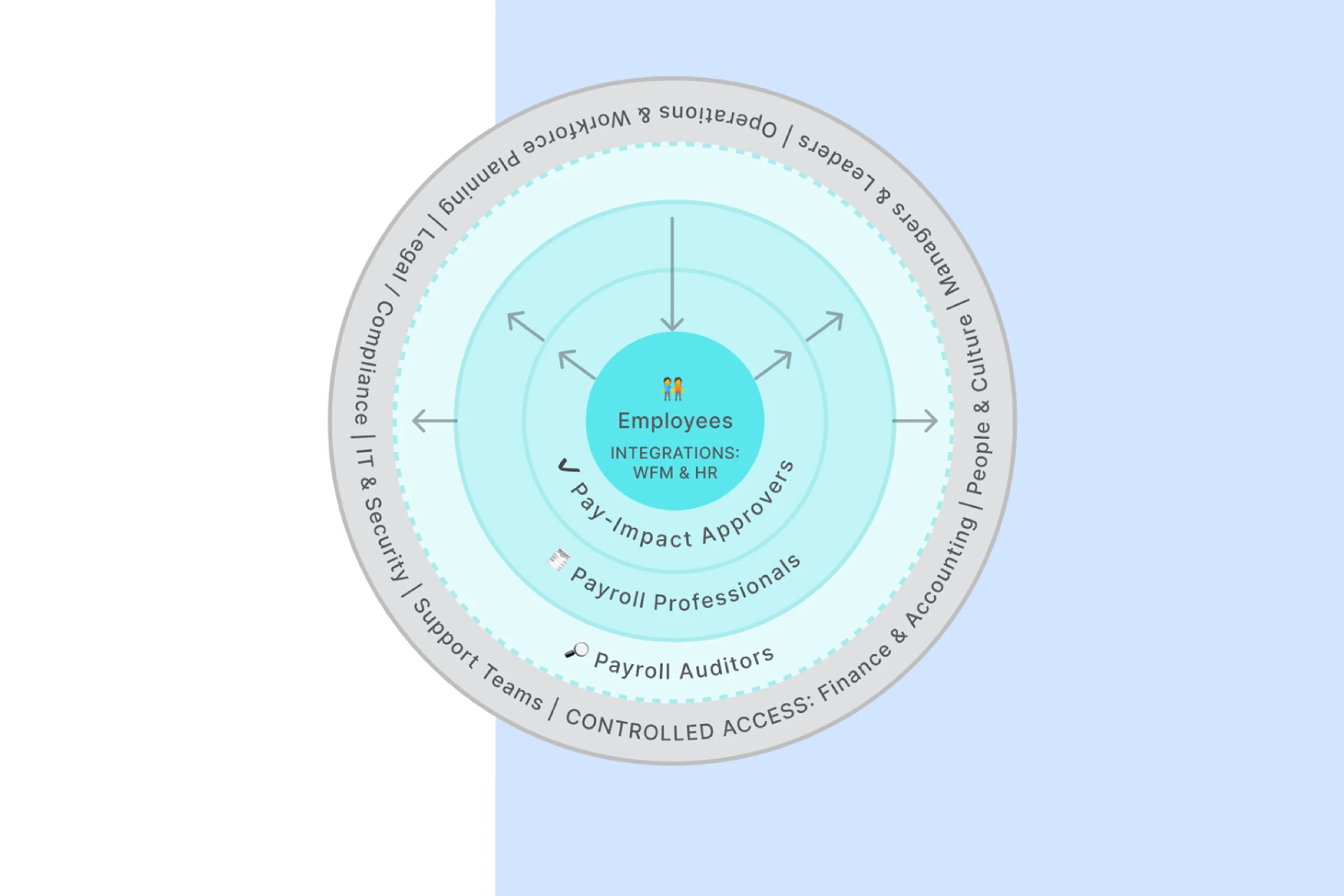
Employee, approver, payroll professional: data flows out and back. Auditor and secondary roles, a downstream, controlled view.
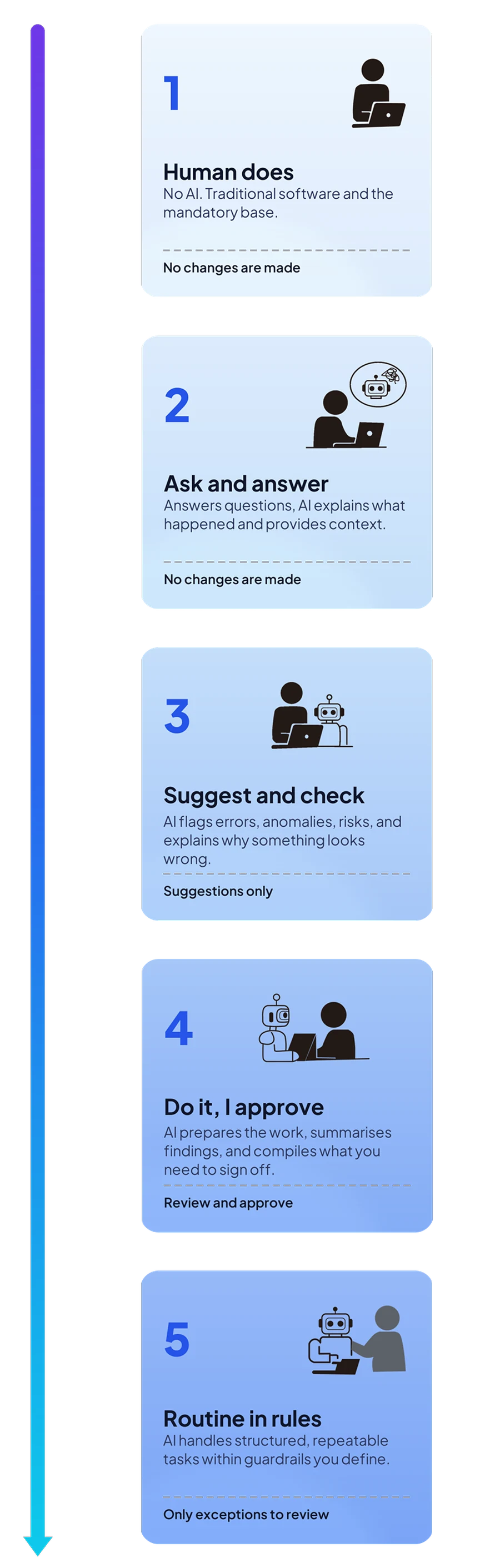
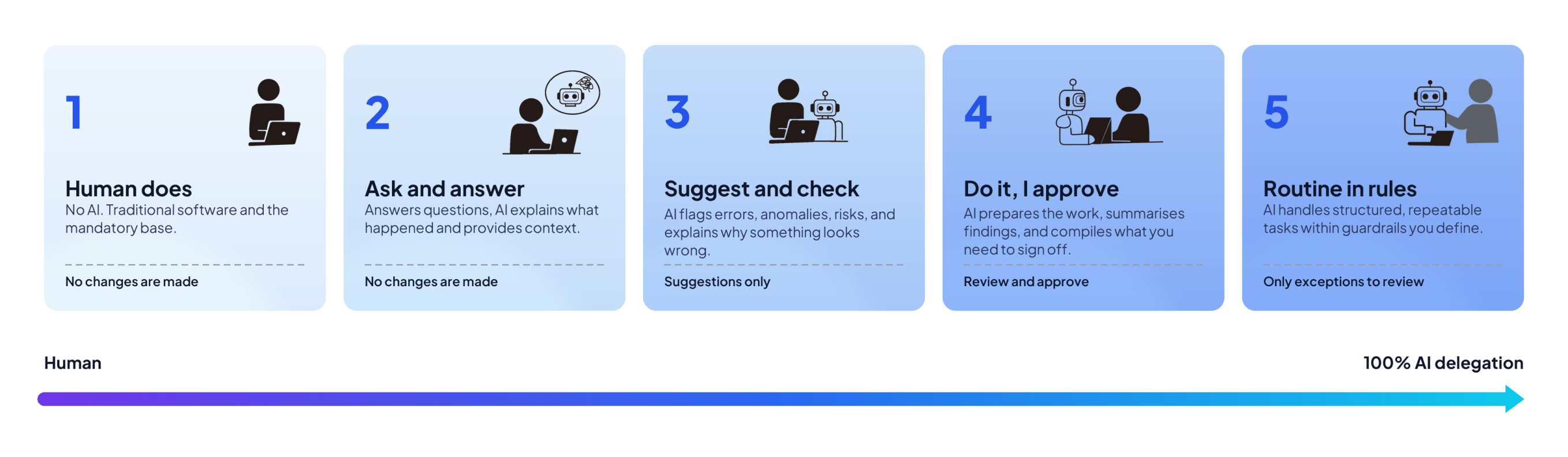
Five levels of delegation, from human does to AI autonomy.
The Calls I Made
1
Built the AI delegation framework before anything else
Given an open brief, it would have been easy to jump straight to a feature. Instead, I adapted Stanford's HAS/SALT scale into D1–D5, a delegation framework for our payroll environment, and presented it to leadership before conducting research to have the evidence of what to build first. That gave us a shared vocabulary for what "delegate to AI" actually means, rather than a single vague ambition.
2
Let the consultants choose the job, not leadership
Using D1–D5 language, I asked managed services team leads and consultants what they'd want to delegate first. The answer was unanimous: getting customer data into Datapay correctly. Data comes in inconsistent, sometimes non-compliant, with missing fields and the wrong terminology, and it creates a constant back-and-forth communication between consultant and customer. I designed for this winning problem, instead of one leadership assumed was a priority.
3
Designed for variable oversight, not one fixed level of automation
The solution wasn't AI replacing the consultant's judgement at a single, uniform level. Consultants told us delegation comfort depended on the task and the person's trust, so the design let autonomy sit anywhere from D2 to D5 rather than forcing one setting across the board. That decision came directly from what consultants said, they needed to keep control and trust in the technology and be confident that it was correct, as payroll is an auditable space.
4
Started gathering customer evidence before anyone asked
Whilst the prototype was in validation, I independently began surveying customers on how they felt about AI in payroll. Nobody assigned this. I wanted to understand sentiment before we committed further, because I suspected the "customers will want full automation" assumption hadn't been tested, and we would see variety of sentiments across the board (especially given the demographic of our customers).
The Solution
The real problem wasn't just our internal consultants receiving bad data. It was three separate failure points: data arriving incomplete, unclear, or non-compliant from the customer. That data needed to be mapped into the right place, and someone needing to confirm it was correct before it went further. Treating that as one step would have missed where the actual friction was.
I designed a two-sided flow. On the customer side, I built a payroll admin view where the customer uploads and checks their own information before it reaches the consultant, shifting a small amount of effort back to where the data originates and cutting the back-and-forth between admin and consultant. Here AI does the deterministic mapping and flags to the customer when something need their attention or has a nother suggestion. Over tiem the AI will learn the customer terminology and be able to talk in their alguage (noting this customers usually have not payroll experts and don't use Datapay speak). Once the customer is happy they send through the information, and the consultant picks it up. For changes they're confident in, AI makes the update and the consultant reviews it. For anything else, they handle it manually.
This is where D1–D5 did real work. Consultants weren't comfortable at a single autonomy level across the board. Most sat around D3, but it varied by task, some were happy to let AI run at D5, others wanted to stay at D2, and it also varied by person, since individual attitudes to AI differ and aren't fixed. That variability was one of the strongest insights to come out of validation: delegation isn't a single dial, it has to be set per payroll task.
I built this as an HTML prototype and validated it with payroll consultants across three rounds, refining the flow each time based on what they flagged. I worked with lead AI engineers to confirm it was technically feasible before taking it further. The business case was straightforward: faster processing time for consultants, and space for them to focus on higher-value work customers would pay for.
The prototype was paused before build due to a resourcing and leadership shift. It's ready to pick back up when prioritised.

Validating with SMEs, shaping the market canvas.
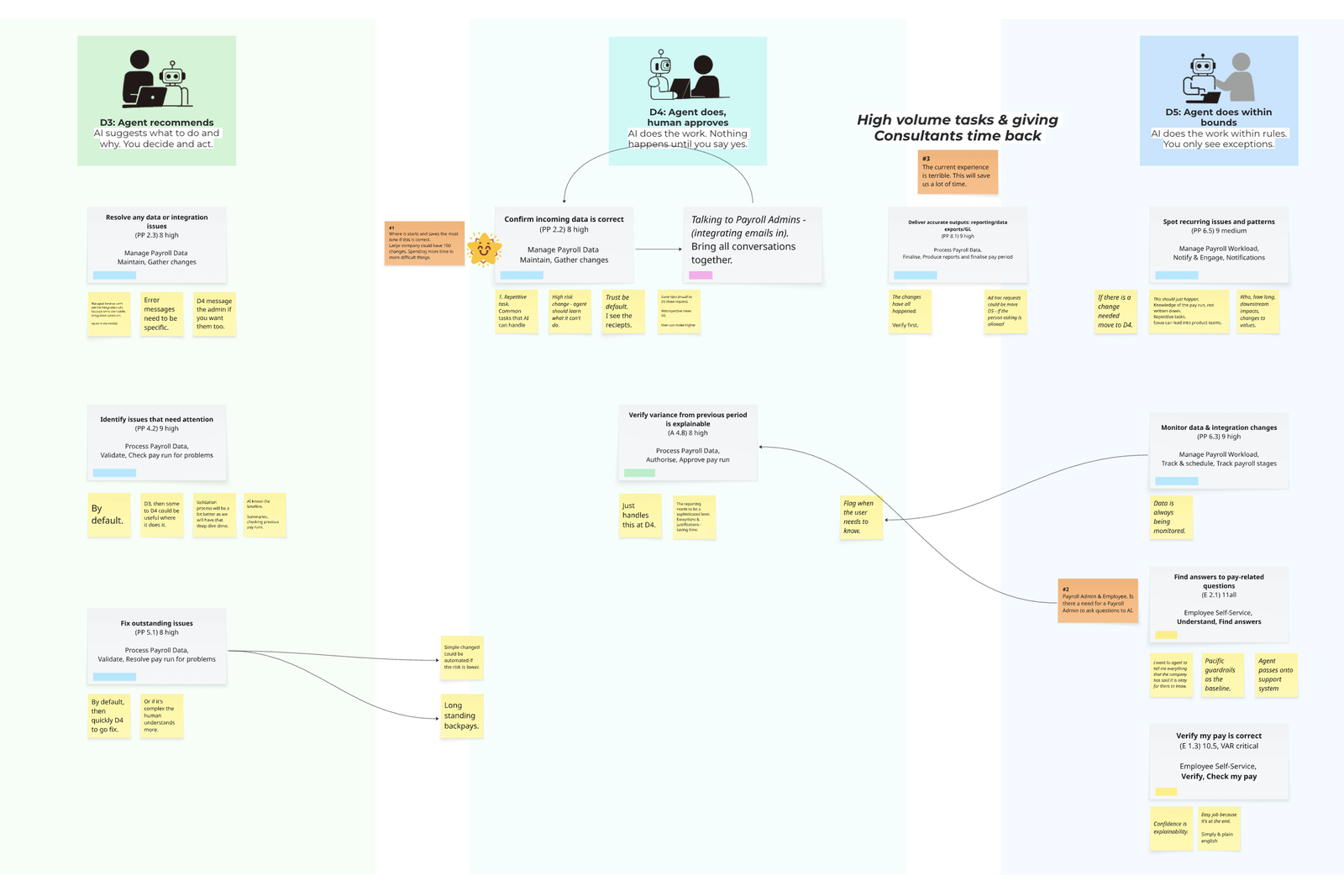
1 of 5 high opportunity JTBD AI delegation workshops
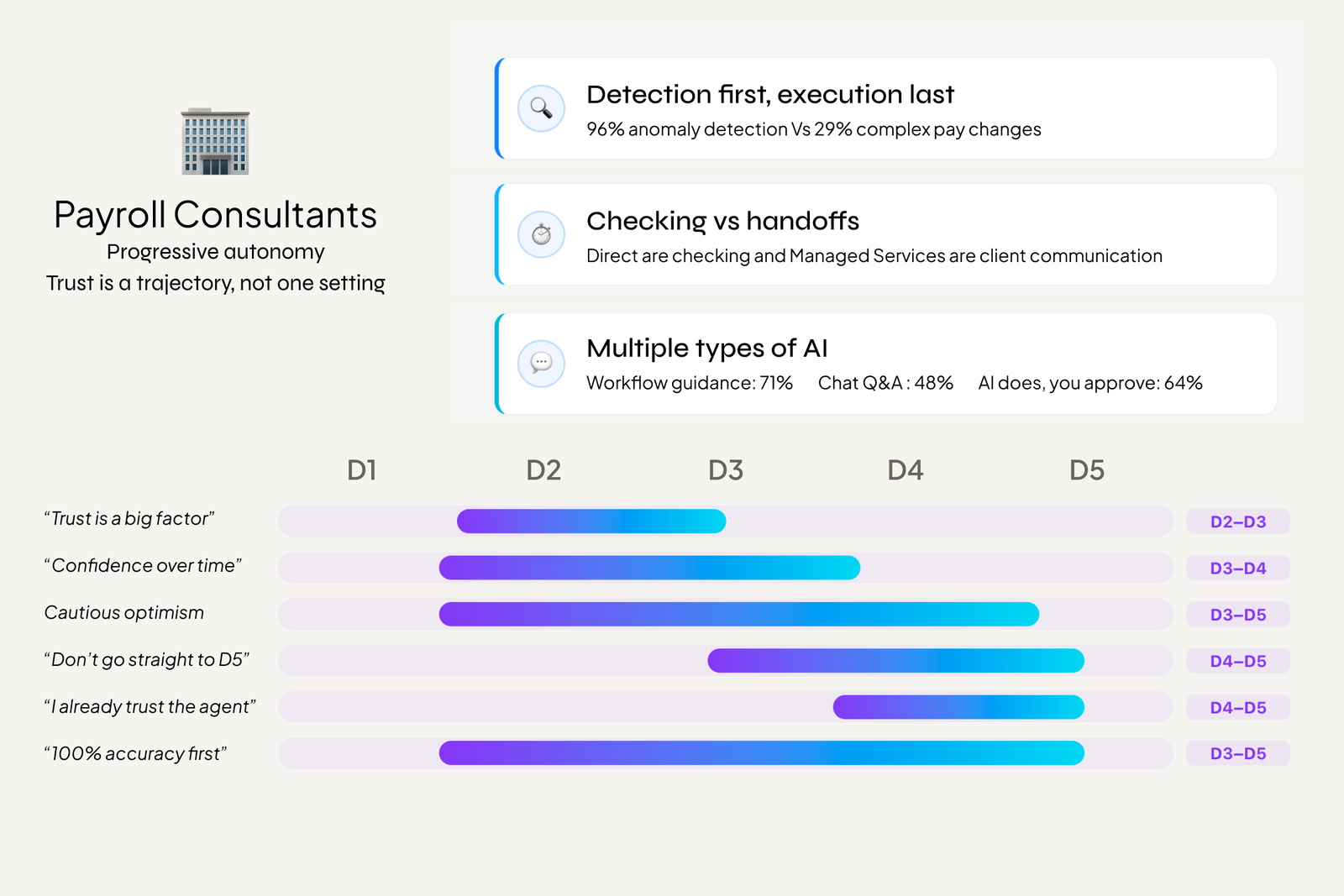
Survey insights showing delegation differences by sentiment
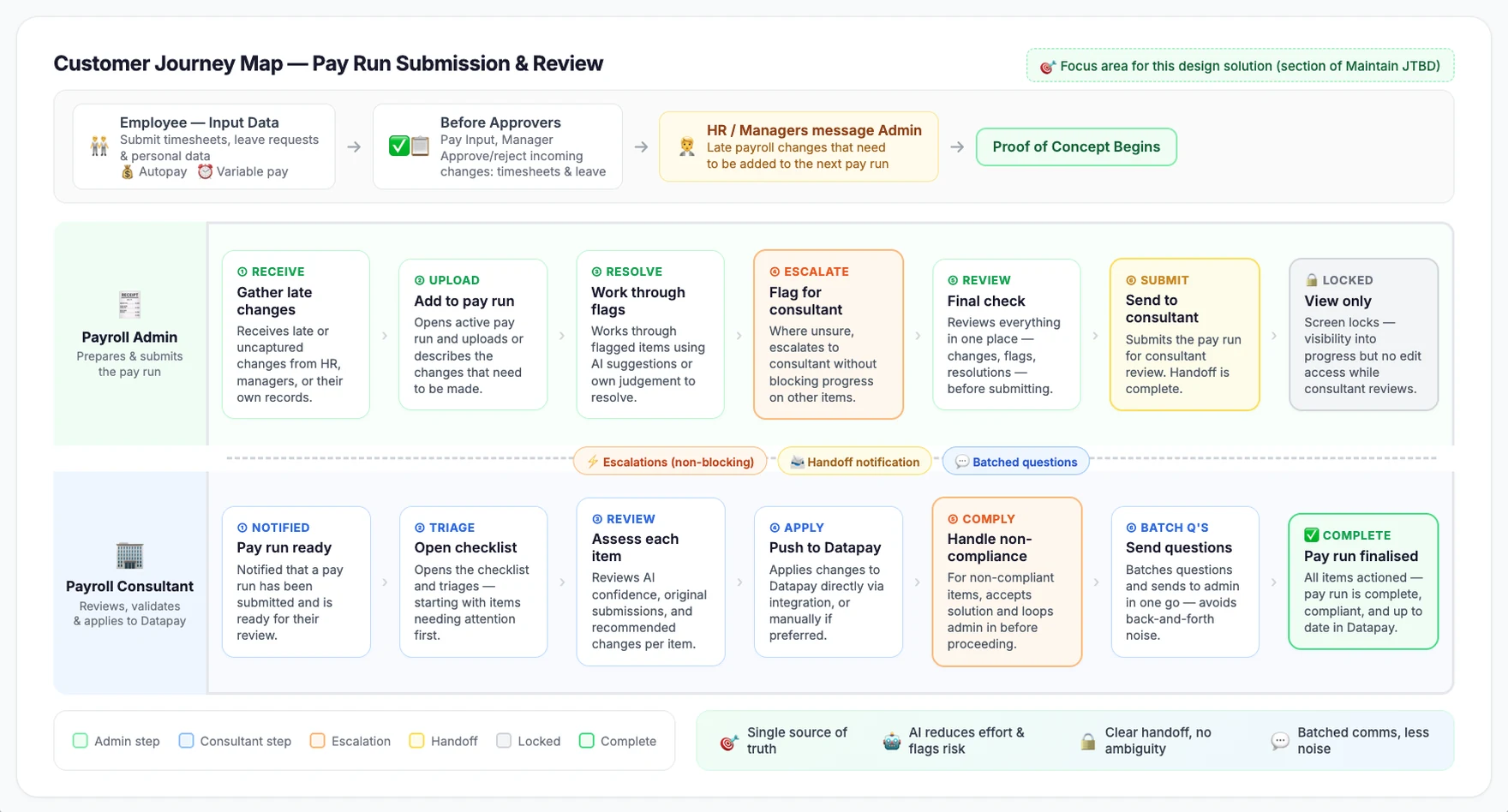
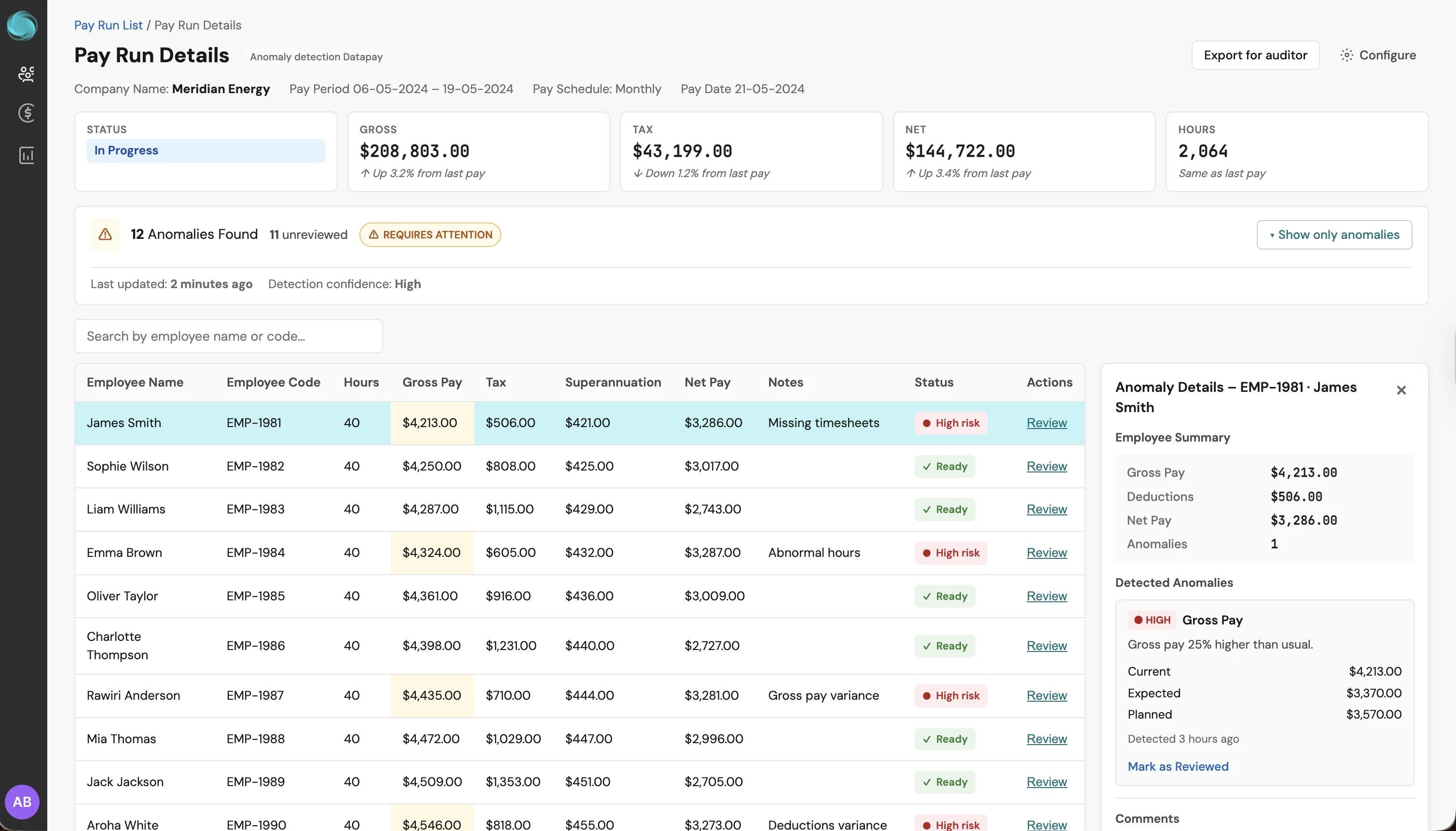
The winning AI job, confirming incoming data is correct, Admin submits and Consultant reviews.
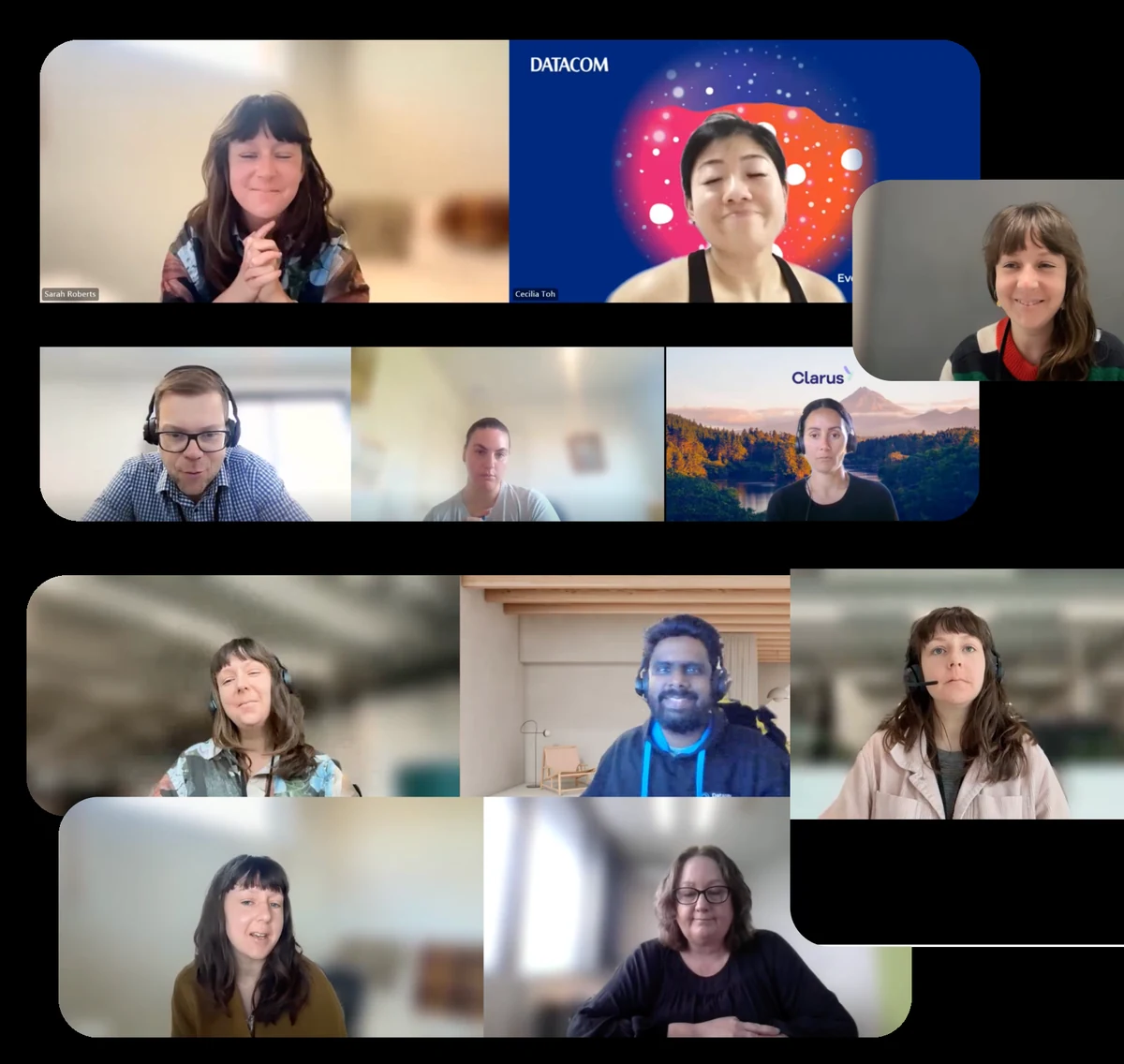
Workshops with customers: AI and reporting needs
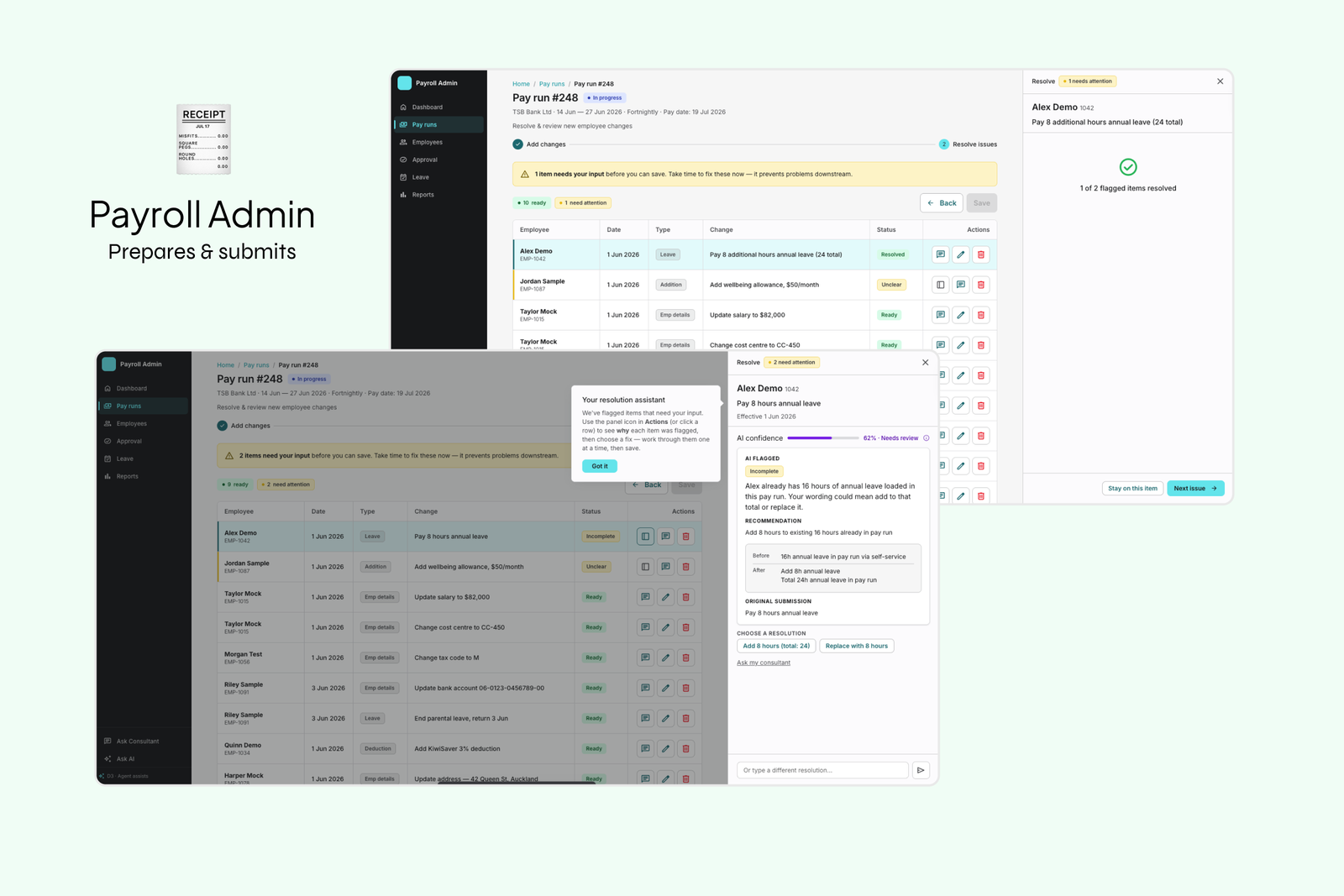
Payroll Admin first agentic experience
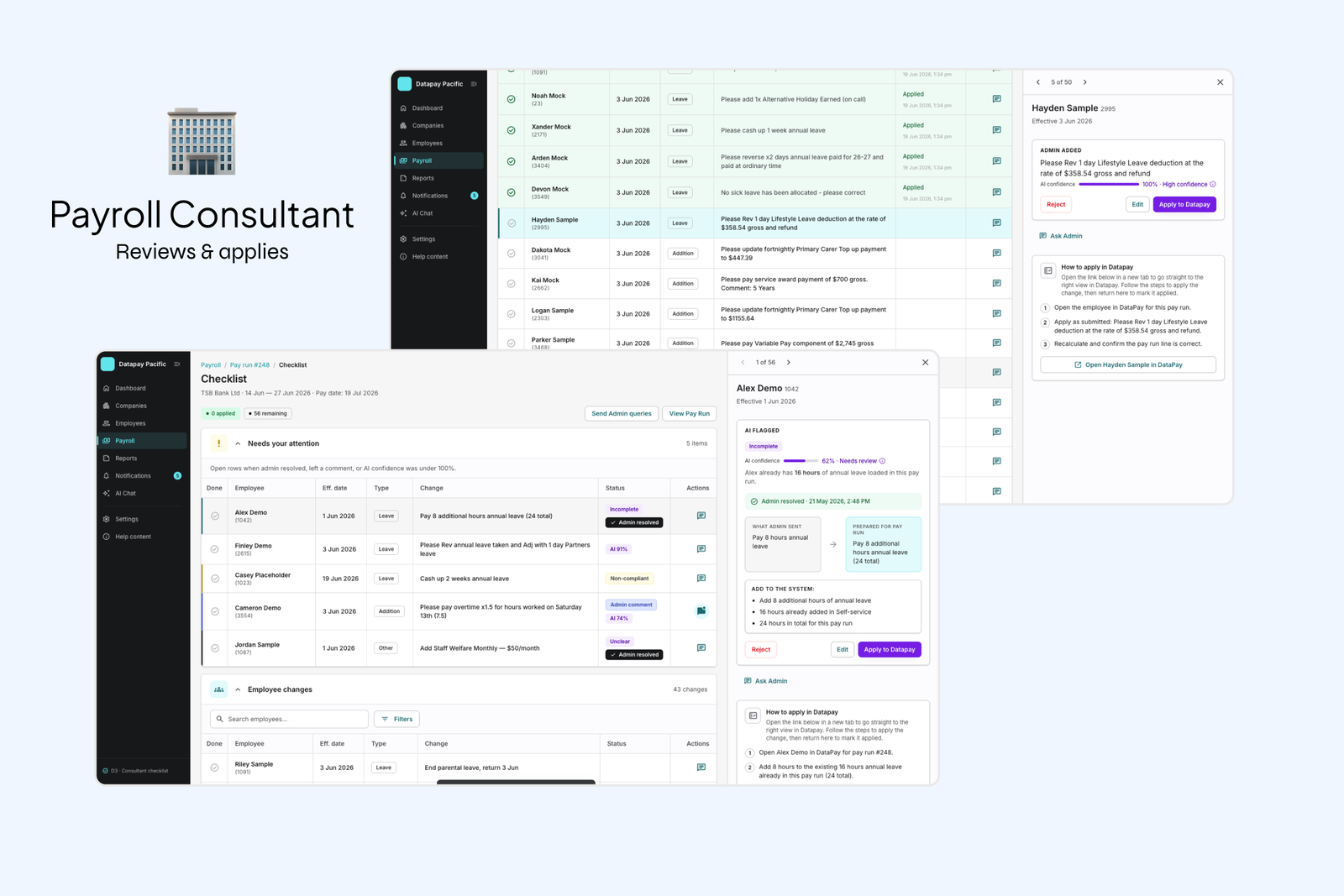
Payroll Consultant agentic checklist and apply to Datapay
The Shift
Before: No shared language for what AI should and shouldn't take on. An assumption from leadership that all of our customers wanted full automation where possible. There was AI conversations happening without the customer or consultant input.
After: The AI D1–D5 scale is embedded in our discovery language and used to define how we measure success on AI work. It's been validated with customers three times since. The customer survey I ran independently, combined with a CAB session, surfaced that customers do not want a fully agentic future, and that evidence changed the internal conversation about direction.
Customer facing staff now bring customer conversations to me directly so we can continue to build up our customer understanding and keep a pulse on how this will shift overtime.
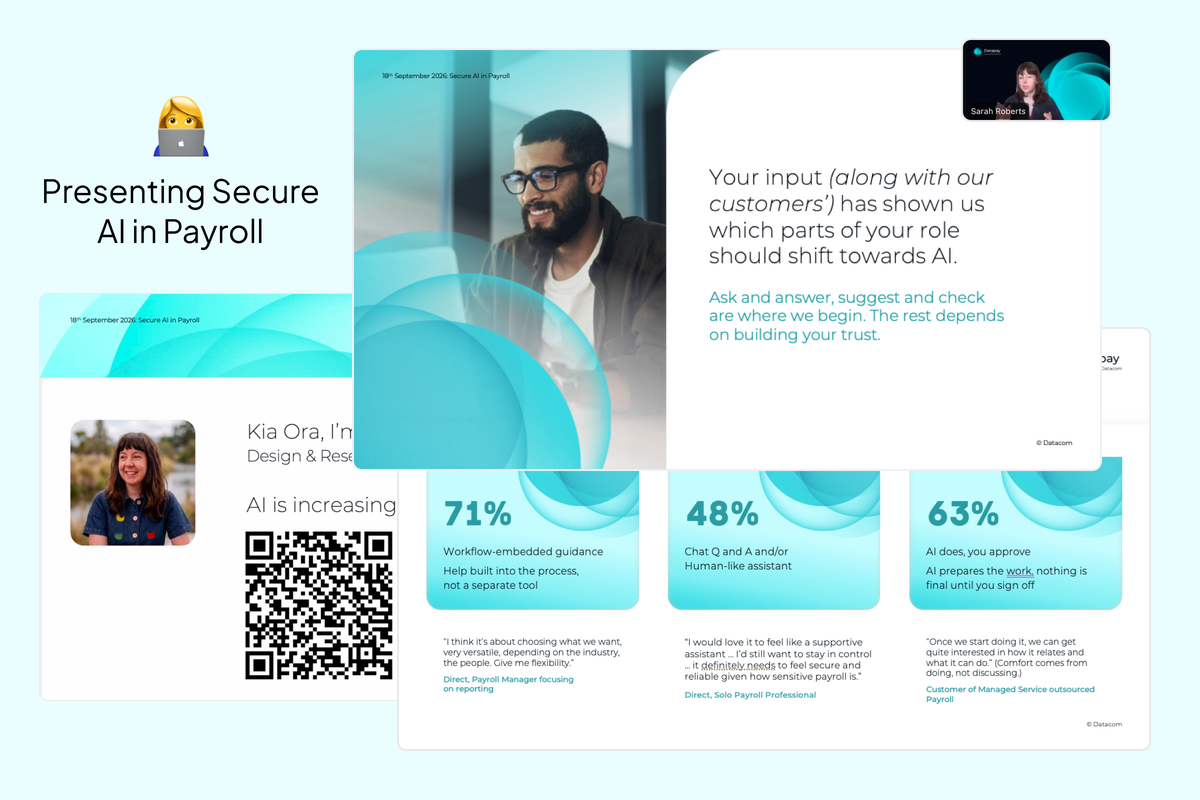
Presenting Secure AI in Payroll to NZPPA
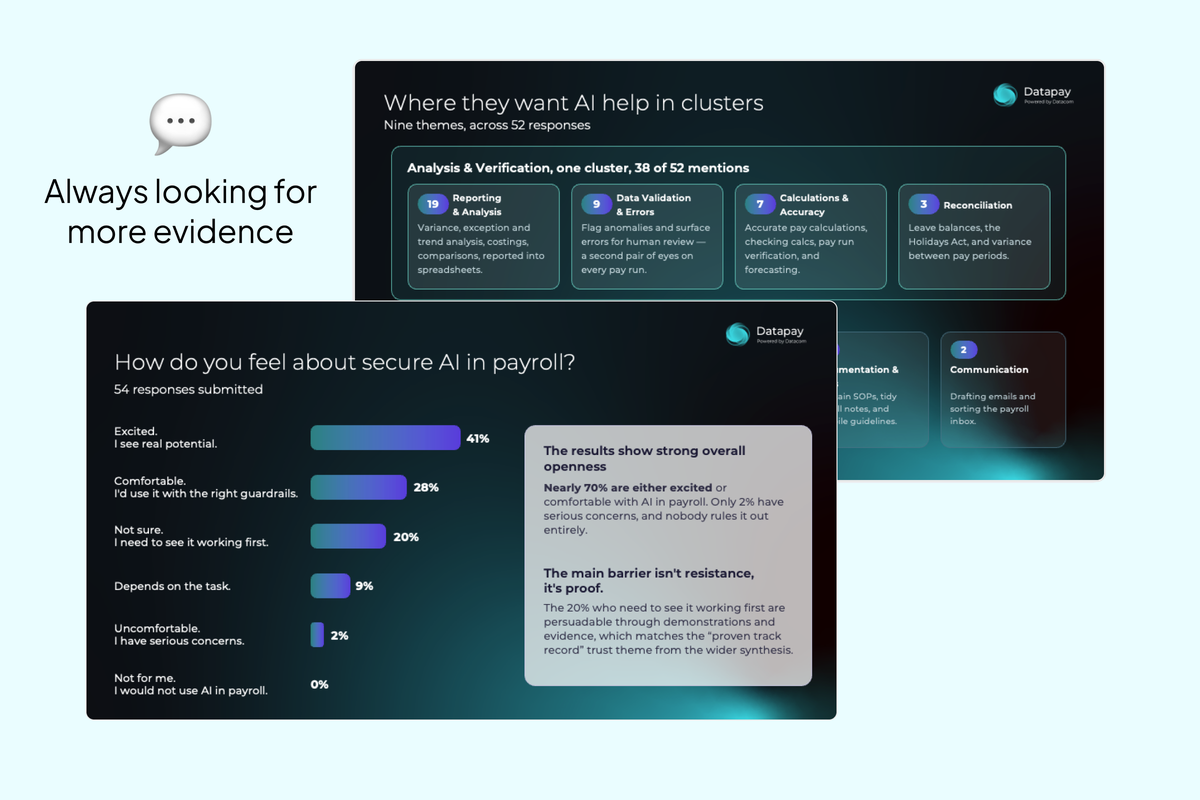
Sentiment shifts constantly, so evidence gathering never stops.
The Outcome
93/100
CAB satisfaction
Satisfaction from our Customer Advisory Board (CAB), our highest-rated session yet.
12
NZ payroll experts
validated the D1–D5 AI delegation framework directly.
Beyond the framework itself, the confirmed signals so far:
D1–D5 adopted as shared language across product, embedded in discovery and success measures.
Consultants unanimously identified the delegation priority themselves, rather than it being assigned top-down
Cross-team pull: account managers, their manager, and the GM of Customer Success now route customer conversations through me
Presenting this research externally at the NZ Payroll Association this week, the first time this work has gone beyond Datapay
“
She genuinely cares about understanding the customer experience, listening deeply and empathising with their pains, and bringing those insights back to the team. The dedication she's shown hasn't only strengthened our understanding of customer needs, it's brought others along on the journey, helping us become more customer-focused as a team.
Kathy, Senior Product Designer

“
Everyone has varying confidence in AI, but we are all on the same track on what we would like to use it for in payroll... The whole day was worthwhile, and I think the best to date.
CAB participant

What I Learned
1
Framework before feature
Given an open brief, the temptation is to show up with a solution. Building the language first meant leadership, consultants and customers were talking about the same thing, when we got to the harder conversations.
2
Customer evidence outranks internal assumption, even when the assumption comes from leadership
The "customers want full automation" belief was sincere, but it was untested, and I only had standing to challenge it because I'd already gone and asked.